

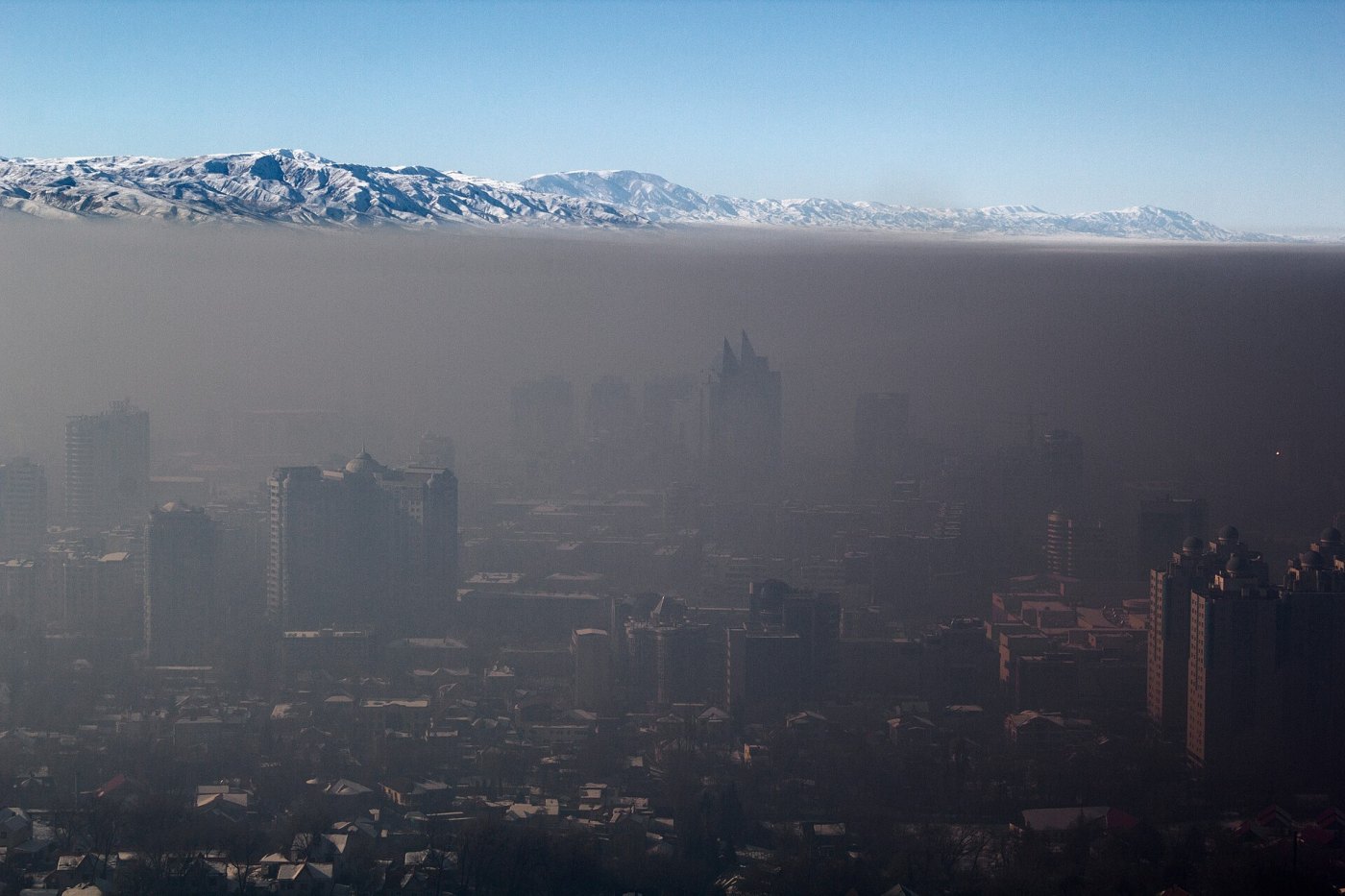
On a still winter morning, the view from the hills above some Central Asian cities can be startling: snowy mountain peaks glow in clear blue sky, while the city below lies hidden under a brown-grey blanket of smog. Most people think of such air as a problem for the lungs, and it is. But the tiniest particles in that haze do not stay in the chest. Scientists are finding that they can affect the heart, the blood vessels and even the brain, and the World Health Organization (WHO) now counts air pollution among the greatest environmental risks to human health.
What is in the air we breathe
Polluted air is a mixture of gases, such as nitrogen dioxide, sulphur dioxide, carbon monoxide and ground-level ozone, and of tiny solid and liquid particles known as particulate matter (PM). The particles that worry health experts most are labelled PM2.5: they measure 2.5 micrometres across or less, roughly 30 times thinner than a human hair. They come mainly from burning fuel in vehicles, power plants, industry and homes, as well as from farming, dust and waste burning.
The numbers are sobering. According to WHO, in 2019 some 99 percent of the world's population lived in places where air quality did not meet its guideline levels. Outdoor air pollution was estimated to cause 4.2 million premature deaths that year, and together with smoke from household cooking and heating, about 6.7 million deaths a year. In 2021 WHO tightened its guideline for long-term exposure to PM2.5 to an annual average of 5 micrograms per cubic metre of air, half the previous level, because evidence showed harm at lower concentrations than once thought.
From the lungs to the blood, and the brain
Larger particles are mostly trapped in the nose and throat. PM2.5, however, can travel deep into the lungs, and WHO notes that the finest of them can even pass into the bloodstream. Once there, they and the chemicals attached to them can trigger inflammation, the body's alarm response, and oxidative stress, a kind of chemical damage to cells caused by unstable molecules. Over time this can stiffen and damage blood vessels throughout the body, including those that feed the brain.
There may also be a more direct route. In 2016 a team led by the British scientist Barbara Maher examined brain tissue from people who had lived in Mexico City and in Manchester, England. They found large numbers of tiny magnetic iron-oxide particles called magnetite nanoparticles. Their rounded shape matched particles formed at high temperatures, such as in engines and fires, and differed from the magnetite the body makes itself. The researchers suggested that particles smaller than about 200 nanometres could reach the brain through the olfactory bulb, the small structure just above the nose that processes smell. This does not prove that the particles cause disease, but it shows that pollution can get inside the human brain.
Stroke: the clearest link
The best-established brain effect of air pollution is on stroke, which happens when blood flow to part of the brain is blocked or a blood vessel bursts. WHO estimates that about 68 percent of premature deaths caused by outdoor air pollution in 2019 were due to ischaemic heart disease and stroke combined. Polluted air is thought to raise blood pressure, promote blood clotting and speed up the build-up of fatty deposits in the arteries, all of which increase the risk of stroke.
Dementia and the developing brain
Evidence on long-term brain health is newer but growing. In its 2024 report, the Lancet Commission on dementia, an international group of leading experts, listed air pollution as one of 14 risk factors that can be changed. Together, these factors are linked to nearly half of dementia cases worldwide, which means that a large share of dementia could, in principle, be prevented or delayed. The Commission also noted studies in which improvements in air quality were followed by better thinking skills and lower dementia risk. When WHO updated its guidelines in 2021, it likewise noted that evidence was emerging of links between air pollution and neurodegenerative conditions, diseases in which brain cells are gradually lost.
Children may be especially vulnerable, because they breathe faster than adults relative to their size and their brains are still developing. WHO calls air pollution one of the greatest environmental risks to child health. Some studies have linked high exposure in pregnancy and early childhood to effects on learning and attention, although it is hard to separate the effect of polluted air from that of poverty, noise and other factors that often come with it. Researchers are still working out how strong these effects are.
Why this matters in Central Asia
For many cities in our region, this is not a distant problem. A World Bank report on air quality in Central Asia, published in 2025, found that concentrations of PM2.5 often exceed the WHO guideline by 6 to 12 times, especially in the largest cities and in winter. It attributed more than 65,000 premature deaths in Central Asia in 2021 to outdoor PM2.5 and estimated the related health costs at 15 to 21 billion US dollars a year, about 3 to 5 percent of the region's economic output. According to the report, the main source of fine particles in all Central Asian cities is the burning of solid fuel to heat homes and other buildings, with traffic as another important source. Cities such as Almaty, Astana, Bishkek and Tashkent are among those it examined. The report also listed better cognitive development in children among the benefits of cleaner air.
What can be done
Most sources of air pollution are beyond the control of any one person, so the biggest gains come from cleaner heating, transport, energy and industry, and from proper monitoring. WHO estimates that almost 80 percent of deaths related to PM2.5 could be avoided if the world reached its updated guideline levels. Individuals can still reduce their own exposure: checking local air quality readings, limiting hard outdoor exercise on heavily polluted days, avoiding burning coal, wood or rubbish in poorly ventilated homes, and, where possible, using air purifiers with fine-particle filters indoors. People with heart or lung disease, older adults, pregnant women and parents of young children should ask a doctor how best to protect themselves.
Many questions remain open. Scientists do not yet know exactly which pollutants matter most for the brain, how much of the damage is reversible, or whether there is any truly safe level of exposure. What is already clear is that clean air is not only about easier breathing. It is also about protecting the organ that makes us who we are.
Sources: World Health Organization: Ambient (outdoor) air pollution (fact sheet); World Health Organization (2021): New WHO Global Air Quality Guidelines aim to save millions of lives from air pollution; World Bank (2025): Air Quality Management in Central Asia; The Lancet (2024), Livingston et al.: Dementia prevention, intervention, and care: 2024 report of the Lancet standing Commission; PNAS (2016), Maher et al.: Magnetite pollution nanoparticles in the human brain. Image: Igors Jefimovs / Wikimedia Commons (CC BY 3.0).


Comments
Please login to leave a comment Sign in