

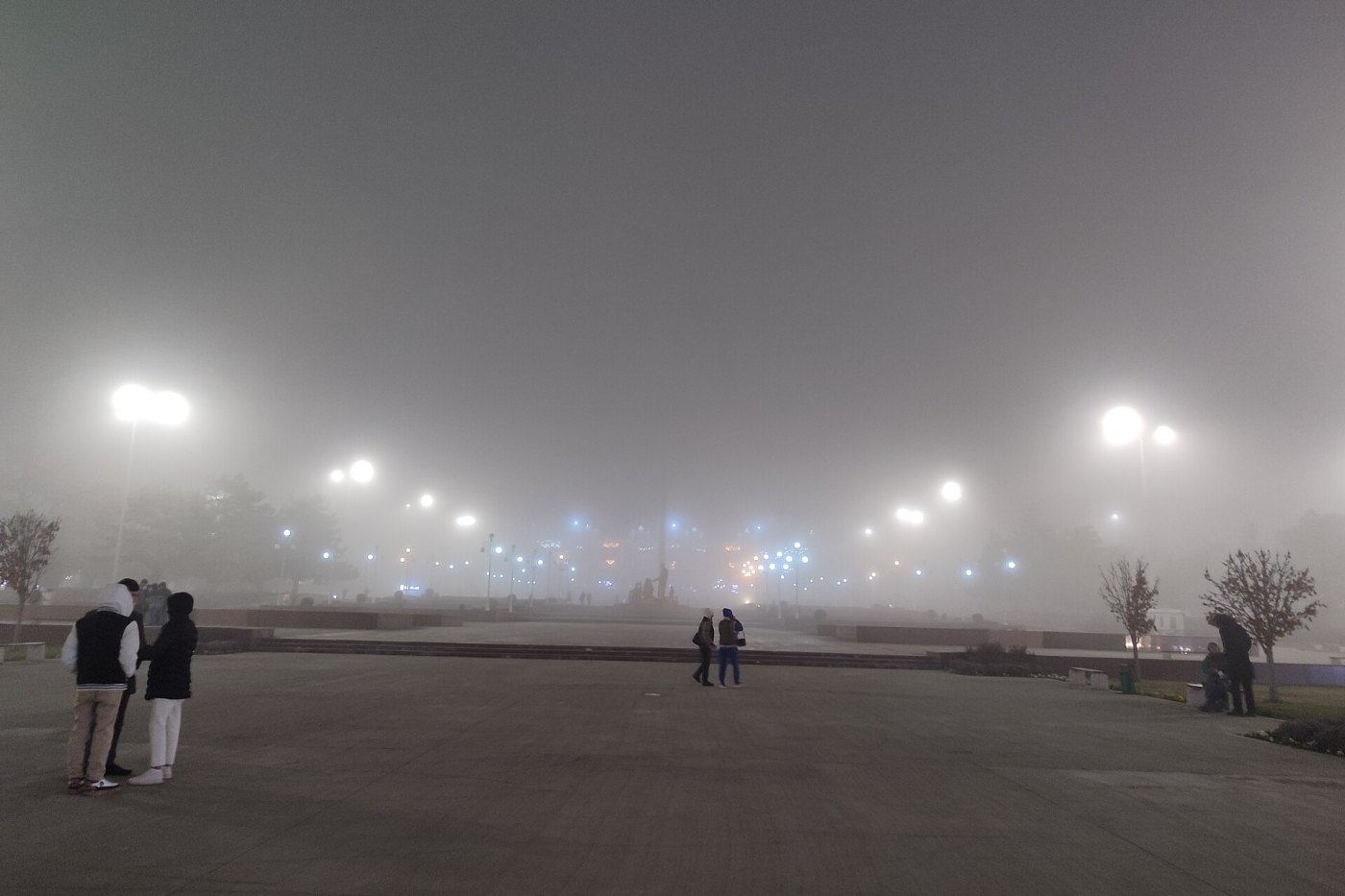
Every November the same grey lid settles over Tashkent. The mountains vanish from the horizon, street lamps glow inside a haze, and air quality apps turn orange and red. But this is not only Tashkent's problem. From Almaty to Bishkek to Dushanbe, millions of people across Central Asia breathe some of the most polluted winter air in the world, and new figures show the problem is getting worse.
One region under the same haze
The 2025 World Air Quality Report by the Swiss company IQAir found that pollution rose in every Central Asian country last year. The report tracks PM2.5, particles smaller than 2.5 micrometres that are small enough to pass from the lungs into the blood. Tajikistan's yearly average reached 57.3 micrograms per cubic metre, up from 46.3 in 2024, which made it the third most polluted country in the world and put it 11.5 times above the World Health Organization (WHO) guideline of 5. Uzbekistan's average rose from 31.4 to 38.1.
The cities tell the same story. In late November 2025, IQAir's live ranking briefly placed Tashkent first among the world's most polluted major cities. In Almaty, winter PM2.5 levels can be up to 17 times the WHO guideline. In Bishkek, daily winter levels often pass 200 micrograms per cubic metre. Karaganda in Kazakhstan, with a yearly average of 72.6, was the most polluted city in the region and the 26th in the world.
Where the smoke comes from
A World Bank assessment of Tashkent, published in 2024, measured the sources. Over the year, heating of homes and businesses produces about 28% of the city's PM2.5, transport 16% and industry 13%, while windblown dust adds 36%, mostly in summer. In winter, heating is the main source. The report also found that 83% of Tashkent's residents live in areas with high pollution.
Across the region the pattern is similar. In Bishkek, a United Nations Development Programme (UNDP) study found that coal burned in household stoves is the main source of dirty air. In Almaty and Astana, the World Bank points to coal burned in homes and in heat and power plants. Geography makes it worse: Almaty, Bishkek and Dushanbe sit beside mountains, and in winter a layer of warm air above the city traps cold, smoky air near the ground, a pattern called a temperature inversion.
What it does to the body and the brain
PM2.5 does not stay in the lungs. The particles enter the bloodstream and cause inflammation throughout the body. The WHO links outdoor air pollution to heart disease, stroke, lung cancer and chronic lung disease, and estimates that it caused 4.2 million premature deaths worldwide in 2019. Children, older people, pregnant women and people with asthma or heart disease are affected most.
The brain is also at risk. Stroke is one of the main ways polluted air kills. In 2020 the Lancet Commission on dementia added air pollution to its list of risk factors for dementia that can be reduced, alongside high blood pressure and smoking. Researchers are still studying how strong this link is and how the particles affect the brain.
The cost in lives and money
The World Bank estimates that PM2.5 in outdoor air caused more than 65,000 premature deaths in Central Asia in 2021, and that the health damage costs the region 15 to 21 billion US dollars a year. In Tashkent alone, polluted air is linked to about 3,000 premature deaths a year and losses of about 488 million dollars, or 0.7% of Uzbekistan's economy. In Kazakhstan, the bank counted more than 10,000 premature deaths and 10.5 billion dollars in yearly losses.
What is being done, and what you can do
Experts agree on the main solutions: replacing coal stoves with gas, electricity or heat pumps, better insulated homes, cleaner fuel and public transport, and more monitoring stations. In November 2023 the World Bank approved a 50 million dollar project to improve air quality in Kyrgyzstan, including help for households to switch to cleaner heating. Progress is slow, so on smoggy days personal protection matters:
- Check an air quality app or website before going out, especially with children.
- On bad days, keep windows closed and move exercise indoors.
- If you must be outside for a long time, a well-fitted FFP2 or N95 mask filters most fine particles.
- If you have asthma, heart disease or another chronic illness, ask your doctor how to prepare for the smog season.
Clean air is not a luxury. The data from Tashkent, Almaty, Bishkek and Dushanbe show a shared problem with shared causes, which means solutions that work in one city can help the others too.
Sources: World Bank: Air Quality Assessment for Tashkent (2024); World Bank: Air Quality Management in Central Asia (2025); IQAir: World Air Quality Report 2025; WHO: Ambient (outdoor) air pollution fact sheet; World Bank: Cost-effective air quality management in Kazakhstan (2022); UNDP: Ditch coal from homes to tackle air pollution in Bishkek; The Lancet Commission on dementia prevention (2020). Image: Muzaffar Murodovich / Wikimedia Commons (CC BY-SA 4.0).


Comments
Please login to leave a comment Sign in