

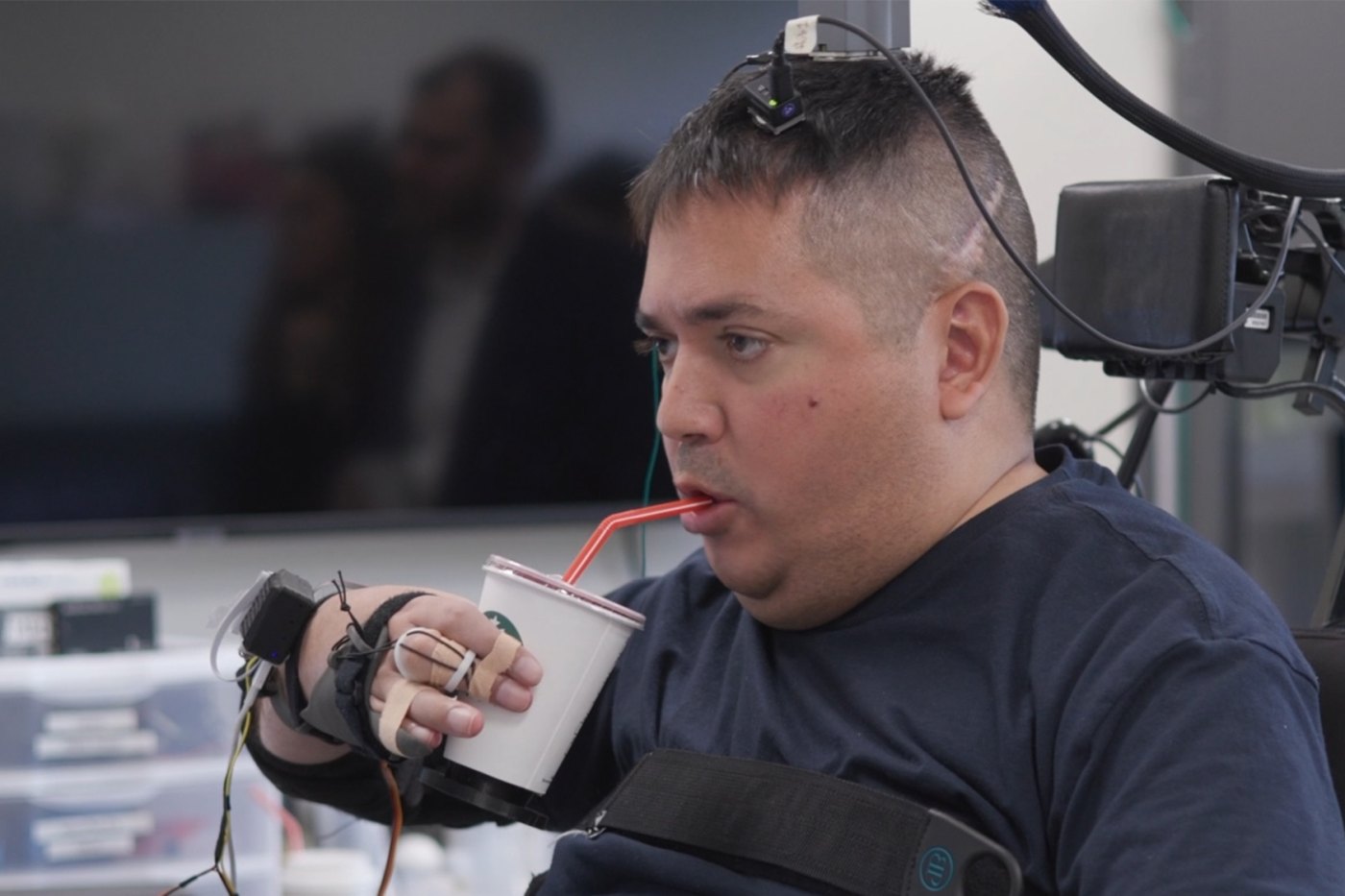
A man paralyzed from the neck down can grasp objects, feed himself and feel touch on his wrist again, using an implant that routes his movement intentions around his damaged spinal cord.
The results, from the Feinstein Institutes for Medical Research in New York, appear in Nature Medicine. Earlier brain-computer interfaces have restored movement; this one goes after sensation and lasting recovery as well.
Two bypasses at once
The participant, Keith Thomas, was left sensory complete at the C4 level of the neck and motor complete at C5 after a diving accident in 2020. Surgeons placed electrode arrays in his motor cortex and in the sensory cortex that handles touch, a setup the researchers call a double neural bypass. Recurrent neural networks trained with reinforcement learning decode his intended hand movements and turn them into patterned stimulation of his spinal cord and forearm muscles, while small currents delivered to the sensory cortex mirror what his hand is doing.
With the system running he could open and close his hand, drink from a cup and feed himself, and he lifted empty eggshells without crushing them 87 percent of the time. The decoder kept recognizing his intentions, with accuracy up to 84.6 percent, for more than five months without retraining, which has been a stubborn problem for implanted interfaces.
Some of the gains outlasted the machine. Over 35 weeks of training, strength rose 86 percent in his right arm and 62 percent in his left, and touch sensitivity at his wrist was still better more than two months after the stimulation stopped. The authors attribute that to neuroplasticity, the nervous system's ability to rewire itself.
"This approach is a new way to treat severe paralysis," says Chad Bouton, the study's corresponding author at the Feinstein Institutes.
This is one person with one pattern of injury, and the hardware is elaborate: surgically placed arrays, wearable stimulation patches and trained staff to run it. The team says the next step is more participants with a range of spinal cord injuries.
Sources: The Feinstein Institutes for Medical Research; Nature Medicine (original study). Image: Feinstein Institutes for Medical Research.


Comments
Please login to leave a comment Sign in