

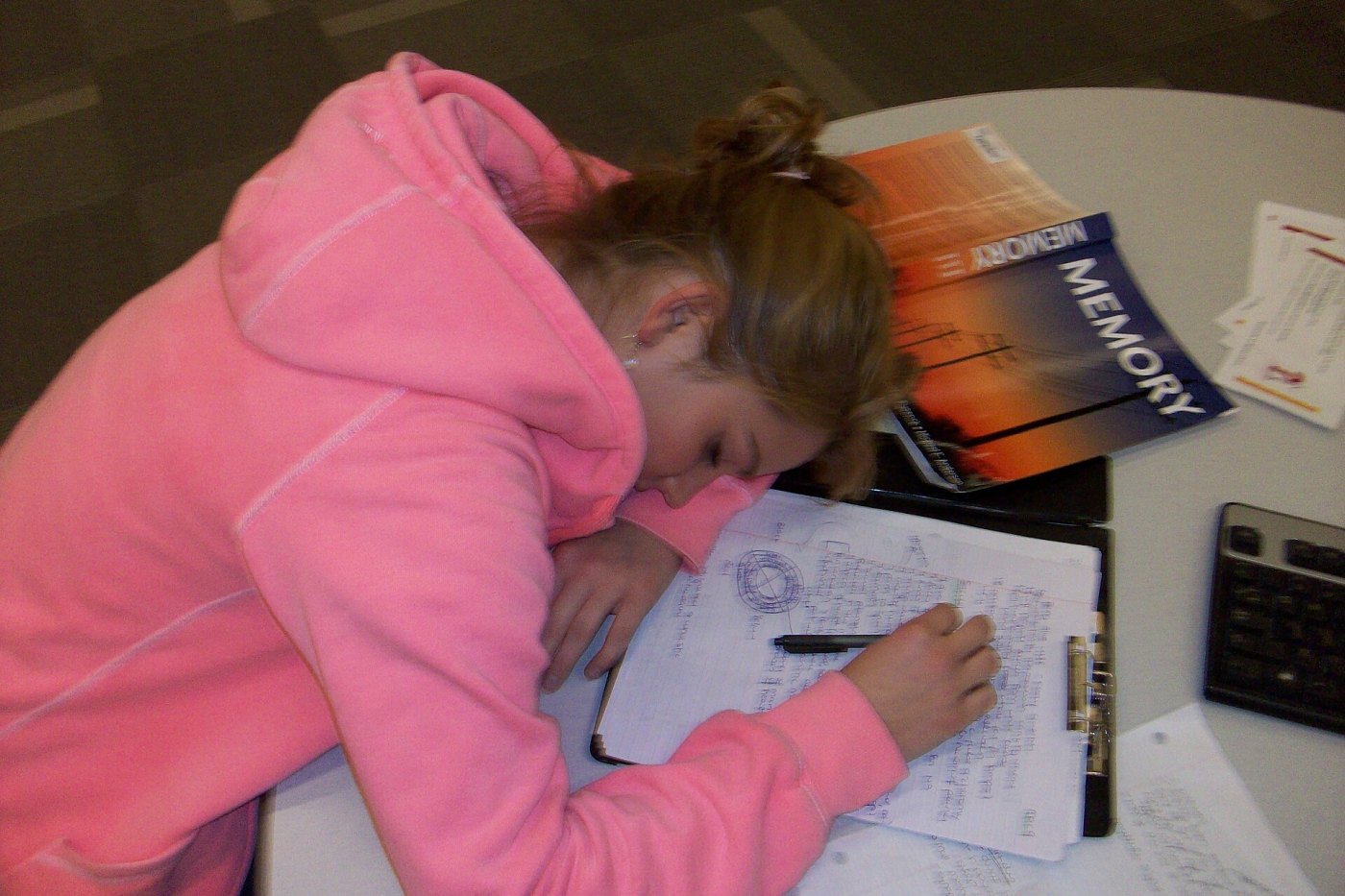
The night before an exam, many students make the same trade: a few more hours with their notes in exchange for a few hours less sleep. Neuroscience suggests this is often a poor deal. Far from being a pause button, sleep is when the brain does some of its most important work on memory: sorting through the day's experiences, strengthening what matters and filing it away for the long term.
A century-old clue
One of the first hints came in 1924. At Cornell University in the United States, the psychologists John Jenkins and Karl Dallenbach asked two volunteers to memorise lists of nonsense syllables and then tested them after intervals spent either asleep or awake. After sleeping, the volunteers remembered noticeably more than after the same number of hours of ordinary daytime activity. Jenkins and Dallenbach thought sleep simply shielded memories from interference, the clutter of new experiences that can crowd out older ones. That is part of the story, but later research showed that the sleeping brain is anything but passive.
Two kinds of sleep, repeated through the night
Sleep is not one single state. It has two main types. Non-REM sleep includes light sleep and deep, or slow-wave, sleep, in which large groups of brain cells fire together in big, slow waves. REM sleep (rapid eye movement sleep) is when the brain is highly active, the eyes dart beneath the lids and most vivid dreams happen. A night is made up of several cycles of these stages. The first REM period usually begins about 90 minutes after falling asleep. Deep sleep dominates the first half of the night, while REM periods grow longer towards morning.
Each stage seems to contribute something different. Deep sleep appears to be especially important for declarative memory, the facts and events you can consciously recall, such as new vocabulary, dates or where you left your keys. Lighter stage 2 sleep, with its short bursts of brain activity called sleep spindles, has been linked to motor skills as well as to learning facts. REM sleep may help to process emotional memories and to connect new knowledge in unexpected ways, although the evidence for REM is more mixed.
Replaying the day
To understand how a memory becomes lasting, it helps to know where it starts. New experiences are first captured with the help of the hippocampus, a curved structure deep inside each side of the brain that works like a fast but limited notepad. Over time, memories come to rely more on the neocortex, the brain's large outer layer, where long-term knowledge is stored. This gradual handover is called systems consolidation.
In 1994 Matthew Wilson and Bruce McNaughton at the University of Arizona caught a glimpse of this process at work. They recorded from dozens of "place cells" in the hippocampus of rats, neurons that fire when the animal is in a particular spot. Cells that fired together while the rats moved around during a task also tended to fire together in the slow-wave sleep that followed, much more than in sleep before the task. The brain, it seemed, was replaying the day's experience. Later studies found that such replay often runs many times faster than the original experience and happens during brief, high-frequency bursts in the hippocampus known as sharp-wave ripples.
According to the leading theory, developed by researchers such as Jan Born and Susanne Diekelmann in Germany, the slow waves of deep sleep act like a conductor. Each slow wave helps to line up sleep spindles and hippocampal ripples in a precise rhythm, so that replayed memories can be passed on to the neocortex and woven into what the brain already knows.
Testing the idea in people
Some of the most elegant evidence comes from experiments that gently nudge the sleeping brain. In a 2007 study published in Science, Björn Rasch, Jan Born and colleagues asked volunteers to learn where pairs of matching cards were placed, rather like the children's memory game, while the scent of roses filled the air. When the same scent was released again during the volunteers' deep sleep, they remembered the card locations better the next day. It did not work when the scent came during REM sleep or while the volunteers were awake, and brain scans showed that the smell activated the hippocampus during deep sleep. The method, called targeted memory reactivation, has since been tried with sounds as well as smells.
Skills benefit too. In 2002 Matthew Walker and colleagues at Harvard Medical School taught people to type a short sequence of finger taps, a little like playing a simple pattern on a piano. After a night of sleep, they performed it about 20% faster without losing accuracy, while the same amount of time awake brought no significant gain. The improvement was linked to the amount of stage 2 sleep late in the night, one reason why cutting sleep short in the early morning may cost more than it seems.
Making room for tomorrow
Sleep may also clear space for new learning. The synaptic homeostasis hypothesis, put forward by Giulio Tononi and Chiara Cirelli at the University of Wisconsin-Madison, proposes that learning during the day strengthens many of the connections between neurons, called synapses. During sleep these connections are broadly scaled back, which saves energy and restores the brain's capacity to learn, while the most important traces are preserved. The idea is still debated, but it fits with studies showing that sleep-deprived people find it harder to take in new information the following day.
What it means for learners
The practical lessons are fairly simple. Sleep both before and after learning matters: before, to prepare the brain to absorb new information, and after, to lock it in. Spreading study over several days, with nights of sleep in between, tends to work better than cramming everything into one late evening. Regular sleep times help, and so does protecting the last hours of the night, which are rich in stage 2 and REM sleep. According to the US National Heart, Lung, and Blood Institute, teenagers aged 13 to 18 need 8 to 10 hours of sleep a day and adults at least 7, amounts that many students fall well short of.
Many questions remain open. Scientists are still working out how the brain chooses which memories to keep, what role dreams play, and whether sounds or other cues during sleep might one day help people with memory problems, such as older adults or people with early dementia. What the evidence does not support is learning complex new material, such as a foreign language, from recordings played while you sleep. Sleep cannot replace studying, but it appears to be the step that makes studying stick. Anyone with persistent sleep problems should talk to a doctor.
Sources: Nature Reviews Neuroscience (2010), Diekelmann & Born: The memory function of sleep; Science (1994), Wilson & McNaughton: Reactivation of hippocampal ensemble memories during sleep; Science (2007), Rasch et al.: Odor cues during slow-wave sleep prompt declarative memory consolidation; Neuron (2002), Walker et al.: Practice with sleep makes perfect: sleep-dependent motor skill learning; NIH National Heart, Lung, and Blood Institute: How Much Sleep Is Enough?. Image: Psy3330 W10 / Wikimedia Commons (CC BY-SA 3.0).


Comments
Please login to leave a comment Sign in