

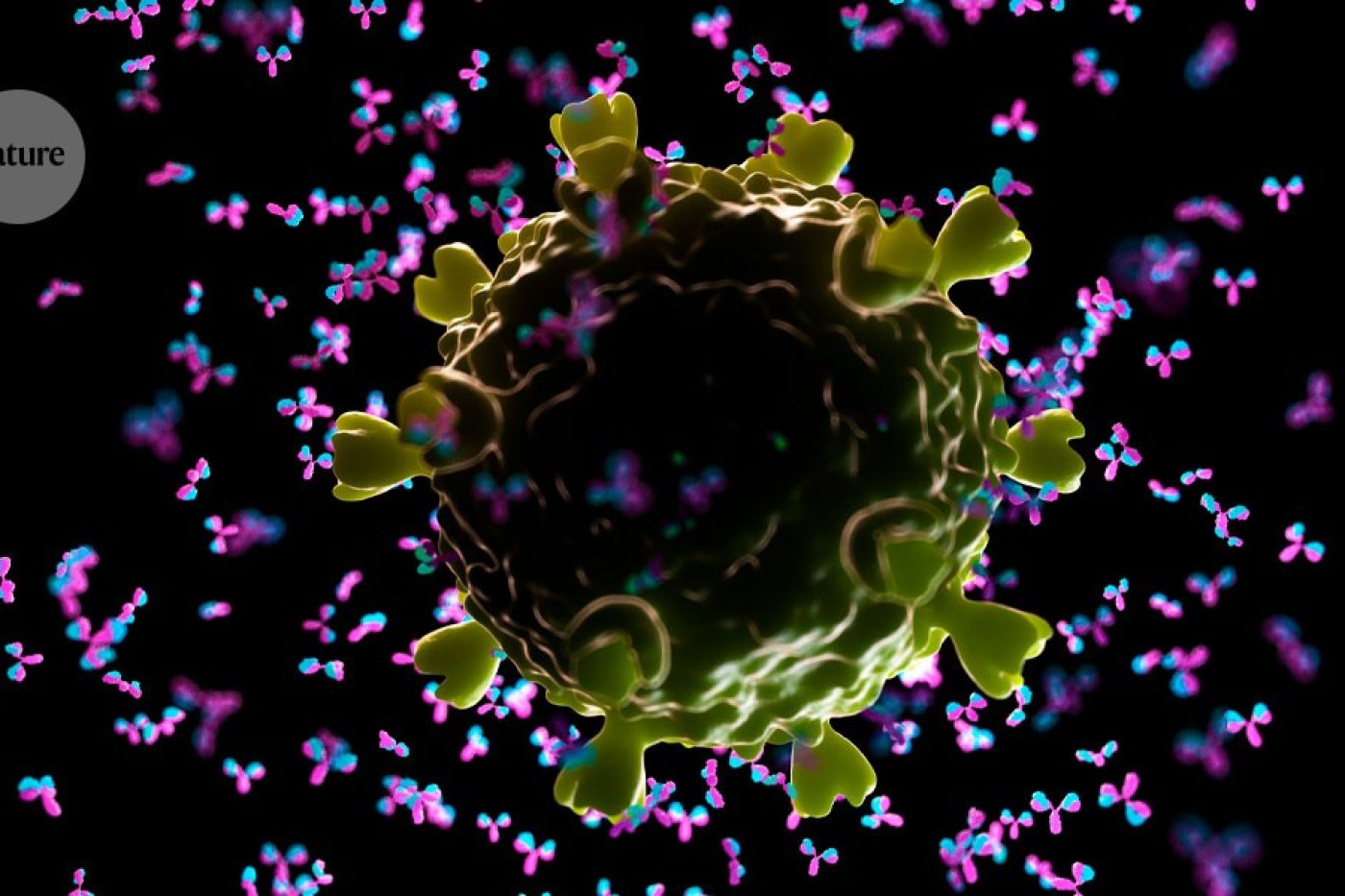
In the mid-2000s, a young woman in South Africa's KwaZulu-Natal province was infected with HIV. Over the following years, as doctors in a research study treated her and regularly sampled her blood, her immune system put up an extraordinary fight. She still needed drugs to control the virus, but the antibodies she made are counted among the most powerful against HIV ever found. Identified in the scientific literature as CAP256, she has become a blueprint for one of medicine's longest-running quests. Scientists now hope that by recreating key features of an infection like hers, they can teach other people's immune systems to make similarly potent antibodies, and finally build a vaccine that stops HIV.
A first in monkeys
This year, several research teams reported vaccination strategies that, in monkeys, trigger broadly neutralizing antibodies, or bnAbs. These are antibodies that can shut down infection by a diverse range of HIV strains before it takes hold. "No one has achieved that before. It's a very important milestone," says Rogier Sanders, a virologist at Amsterdam University Medical Centre. People given components of similar vaccines have produced precursors of these antibodies, which suggests that a working vaccine could be possible with more refinement.
"We have a line of sight to an efficacious vaccine," says Mark Feinberg, president and chief executive of the International AIDS Vaccine Initiative in New York City.
Decades of dead ends
The progress follows a long string of failures. Starting in the 1980s, researchers tried the approach that had worked for viruses such as hepatitis B: inject a lab-made copy of the protein the virus uses to grab hold of cells. For HIV, that is the envelope protein, which latches onto a receptor on human T cells. But HIV mutates so quickly that millions of strains circulate at the same time, and vaccines aimed at one version failed to prevent infection in trial participants. Other strategies, including vaccines that recruited "killer" T cells, also fell short. A 2009 trial in Thailand showed modest signs of protection, but later efforts could not repeat the result, and that approach was abandoned too.
An overarching problem, Feinberg says, was that nobody knew what the immune signature of an effective HIV vaccine should look like, so the only way to judge a candidate was to run a large efficacy trial and hope for the best. "It was all a shot in the dark," says Dennis Burton, an immunologist and virologist at Scripps Research in La Jolla, California.
The turning point was the discovery of bnAbs in people living with HIV, beginning in the 1990s. In the 2000s, Burton's team screened about 1,800 people with HIV and found a pair of highly potent antibodies, made by a donor in Africa, that blocked dozens of strains. "That ignited the field," he says.
Scouting talented immune cells
In people like CAP256, bnAbs develop slowly through what virologist Penny Moore, who analysed CAP256's blood, calls a "cat and mouse game": the virus keeps mutating while the immune system races to catch up. To mimic this, vaccine designers use a sequence of shots. A first "priming" dose wakes up the right B cells, the immune cells that make antibodies. Later doses with different versions of the envelope protein then "shape" and "polish" those antibodies, guiding a process called affinity maturation, in which antibodies gather mutations that make them grip more tightly and work against more strains.
Sanders compares this approach, called germline targeting, to spotting future football stars among young players. "We're scouting the talented B cells," he says.
Teams are scouting in different ways. Moore's group sequenced viruses from CAP256's blood to find what may have triggered and shaped her antibodies. A modified envelope protein from one of those viruses showed promise as a priming shot in monkeys and is now being tested in people, says virologist George Shaw of the University of Pennsylvania, who co-led the preclinical work with Beatrice Hahn. Separately, a team led by William Schief at Scripps Research used computational modelling and cell studies to design a priming molecule called eOD-GT8. In small trials using protein or mRNA versions, nearly all participants made bnAb precursors — antibodies with the right genetic and structural features, but without the full load of mutations that makes bnAbs so potent. Among volunteers who went on to receive a booster built from a different immunogen, the resulting antibodies acquired further mutations that strengthened both their grip on the virus and their ability to neutralize it. "It worked beautifully," Schief says.
Hurdles ahead
Feinberg stresses that success is by no means guaranteed. Effective preventive drugs such as lenacapavir could make it harder to measure how well a vaccine works in trials. And deep cuts to US funding for preclinical and clinical HIV research have left some projects on a precipice. "We're in a better position than we've ever been, and just at this time, we've seen the funding streams cut off," Burton says.
Sources: www.nature.com; Nature (original study). Image: 3DMedisphere/SPL.


Comments
Please login to leave a comment Sign in