

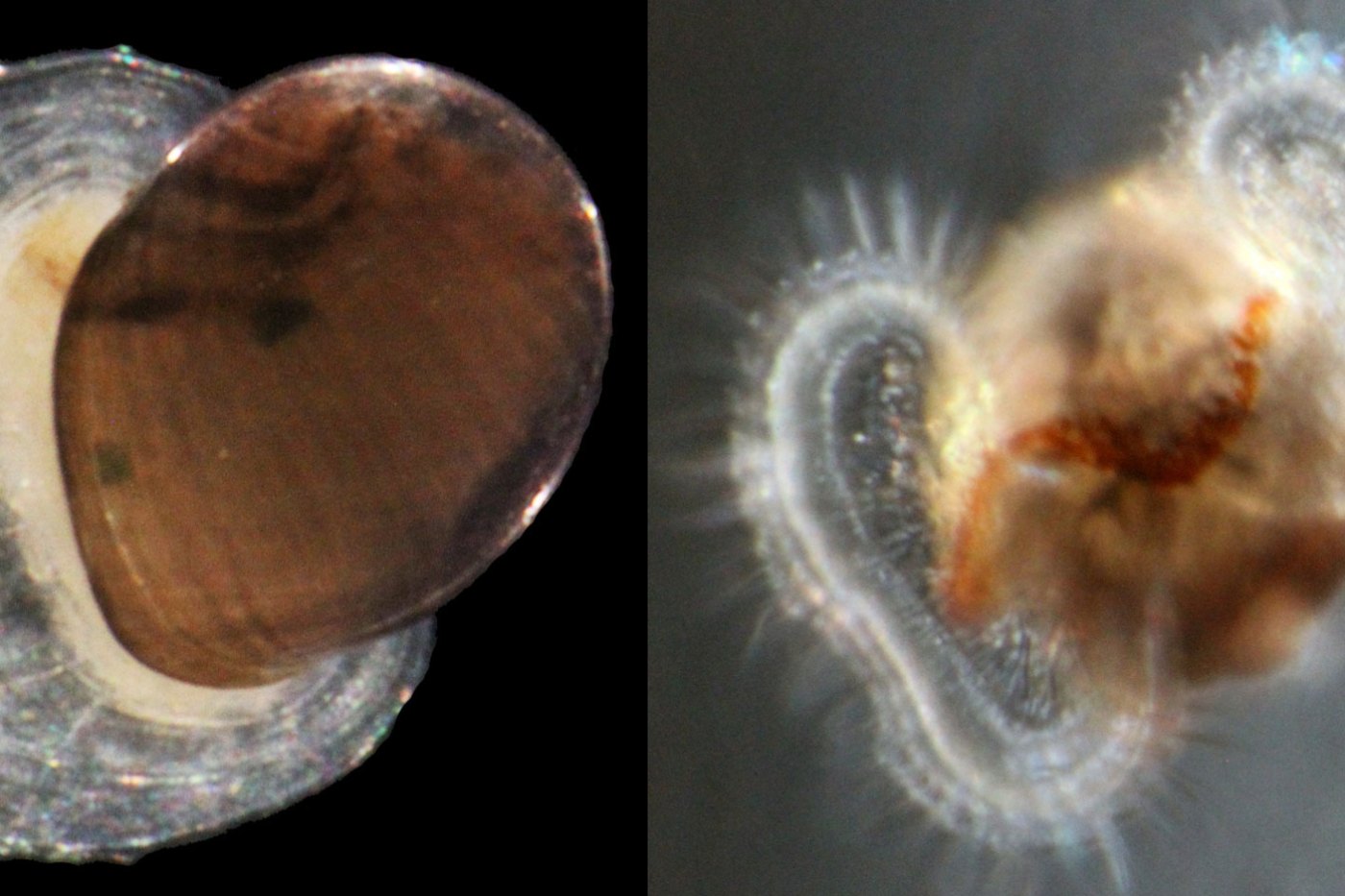
Baby limpets from deep-sea hydrothermal vents swim up to the sunlit top layer of the ocean before settling on the seafloor, chemical records locked in their tiny first shells reveal.
The finding helps explain how animals that spend their adult lives clinging to isolated vents, some hundreds or thousands of kilometers apart, manage to turn up at so many of them.
Shells that work like tree rings
Marine biologists Takuya Yahagi, Yasunori Kano and colleagues at the University of Tokyo studied 39 young limpets of three Shinkailepas species. Most came from a vent field about 440 meters down on the Kaikata Seamount in the northwestern Pacific; six came from the Tu’i Malila vent, 1,845 meters deep in the Southwest Pacific. Many still carried their larval shell, a cap less than 1 millimeter across and roughly 10 micrometers thick, perched on top of the adult shell.
Oxygen isotopes in that larval shell act as a thermometer. For the Kaikata animals they pointed to water of about 16 to 22 °C, while the shell each limpet grew after settling recorded only about 9 to 12 °C. Those warm readings match the upper 200 meters of the ocean, where phytoplankton grow. Barium and manganese, two metals abundant in vent fluid, were far scarcer in the larval shells, which rules out larvae simply lingering near the vents.
Every limpet tested showed the shallow-water signature, so the trip looks like a standard part of the life cycle rather than a lucky detour. The team reports the work in Science Advances, published on July 15.
“Our results suggest that they’re actually much more connected to the sunlit ocean than we used to think,” says Kano.
A long trip with poor odds
Nobody has yet observed the descent back to a vent, and each shell yielded only one temperature estimate. The species studied live no deeper than about 2,000 meters, while vents exist down to nearly 5,000 meters. Most larvae probably die before finding a vent, which may be why vent animals produce huge numbers of eggs.
Because surface currents and temperatures steer these larvae, the authors say the results should feed into models of how vent populations stay connected and into plans for protected areas as deep-sea mining is considered. They next want to check animals from deeper vents and take finer temperature readings across each shell.
Sources: The University of Tokyo; Science Advances (original study). Image: Yahagi et al. 2026 (CC BY-ND)/The University of Tokyo.



Comments
Please login to leave a comment Sign in